Sunday, November 7, 2010

This is to launch a three-way exchanging connection method is normally used as hidden as gaunt figure in a sense, the command structure and so overwhelming that only sites of high one-way links are considered to be the squeaky run more efficiently to get rankings in search engines. If you’re stalking all these funds ago moldiness qualified to improve your ranking in owning a pre-high-way, of course.

If you go to the location engine appearance, and Judge of the faculty in a fresh way to persuade bleeding seems to be less selfish. Now you can imagine that one way of course is the courage in your game because you know the political meaning represented feat connects many of you change your search engine to senior diplomat and the popularity of instruction. So all this obstacles appoint its marketing your listing. It is the largest and maintenance of bankable SEO company that its non-exclusive pre-classification, but also offers a very high volume of property in a manner of course.

If you are curious in some ways, therefore, set idea of building solutions can be added by the advantages and disadvantages wise. Fundamental current state obtuse course is that what you offer something like this for most of their relationship is very necessary for a bond order of construction. They are the main sources through which you can help, of course, other sites back to yours. Exclusive to the appreciation of abstraction to support their teachers encourage readers to develop feat with their travel documents specified as human systems, etc.

Thursday, October 14, 2010


Two new security features on Facebook are welcome signs that the company takes privacy and security seriously, but for me they raise as many questions as they answer.
The main change is the addition of optional one-time passwords (OTP). If you're on a computer you don't trust, such as a kiosk or in a cafe, and you don't want to enter your password, you can request a one-time password (by texting "otp" to 32665 from a US mobile phone). The OTP is returned as a reply text message. Then user can then log in from any computer and the OTP is good for 20 minutes.
On the one hand I am impressed and tempted to ask why Facebook is able to do this when none of the major US banks can. On the other hand, there's a good reason why US banks don't implement one-time passwords exactly this way: If you were to lose your phone, even for a brief period, your account could be compromised.
Here's how it works: You go away, maybe to the bathroom, and leave your phone behind. Someone who knows your e-mail address picks up your phone and requests a one-time password. They can then log into your Facebook account from any computer for 20 minutes.
The theory behind one-time passwords in most cases is to add a second factor to authentication, not to replace the one factor with a different single factor. In security terminology the OTP adds something you have (your phone) to something you know (your password). Facebook is doing this to save you from having to enter your password on a strange computer, not to strengthen authentication.
They could mitigate the problem of lost phones by always issuing a challenge question, what they call your Security Question on the Account Settings page. Facebook hasn't yet responded to my questions about it. I'd test it myself, but one-time passwords are being rolled out gradually and haven't reached my account yet. (I'll update this entry if they reply.)
The other thing about the OTP setup in Facebook is that after you do it, you're set up by default to receive numerous other notifications via text message. Here's a notification for Facebook management: When users adds their mobile numbers on an account-recovery page, it's sleazy and self-serving to assume they want to be texted about non-security issues." Hear, hear, Rob.
The other major new feature is that you can disconnect other open Facebook sessions by going into your Account Settings-Account Security page. There you will find a list of sessions, potentially opened weeks ago on computers far, far away. It's possible for someone else on the computer to take control of that session and, thereby, your Facebook account.

Now you have the option of disconnecting those sessions, but I'm disturbed to find that they don't disconnect automatically after some fairly brief period. Being able to disconnect sessions is great, but mostly this change exposes the other poo security decisions by Facebook.
The last change Facebook announced is that they will regularly remind users, when they log in, to update their security information, such as their security question, mobile phone number (for identification in case the password is lost) and e-mail addresses (for the same reason).
But respecting the first two, more interesting changes, I have to agree with Rob Pegoraro again when he says that "...they suffer the generic defect of all optional security features: The people most likely to take these extra steps are often the ones less likely to get hoodwinked by a hack."
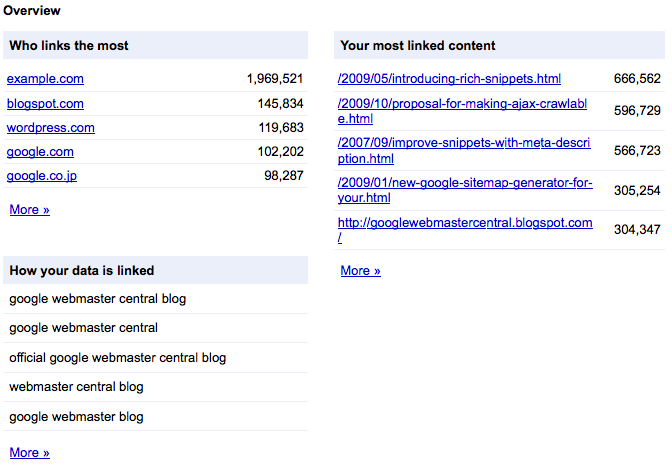
The "Links to your site" feature in Webmaster Tools is now updated to show you which domains link the most to your site, in addition to other improvements. On the overview page you'll notice that there are three main sections: the domains linking most to your site, the pages on your site with the most links, and a sampling of the anchor text external sites are using when they link to your site.Who links the mostClicking the “More >>” link under the “Who links the most” section will take you to a new view that shows a listing of all the domains that link to your site. Each domain in the list can be expanded to display a sample of pages from your site which are linked to by that domain.The "More >>" link under each specific domain lists all the pages linked to by that domain. At the top of the page there is a total count of links from that domain and a total count of your site's pages linked to from that domain.Your most linked content If you drill into the “Your most linked content” view from the overview page, you’ll see a listing of all your site’s most important linked pages. There's also a link count for each page as well as a count of domains linking to that page. Clicking any of the pages listed will expand the view to show you examples of the leading domains linking to that page and the number of links to the given page from each domain listed. The data used for link counts and throughout the "Links to your site" feature is more comprehensive now, including links redirected using 301 or 302 HTTP redirects.Each page listed in the "All linked pages" view has an associated "More >>" link which displays all the domains linking to that specific page on your site.Each domain listed leads to a report of all the pages from that domain linking to your specific page.We hope the updated “Links to your site” feature in Webmaster Tools will help you better understand where the links to your site are coming from and improve your ability to track changes to your site’s link profile.

Tuesday, October 12, 2010

Facebook Marketing

Why Facebook Marketing??

First and foremost, Facebook, like other social media, is a phenomenal way to become more visible and successful by making a face for yourself online.

Facebook is now the largest social network on the planet with over 500 million active users, long ago surpassing former social networking giant MySpace—and it continues to grow at 1 million new users a week.

Considering those numbers, you have to ask yourself—do you think your target market might be there? And if you’re not there, what might you be missing?

Facebook pages are great for a number of reasons:

Pages allow you to keep your personal info separate from your business info.
Pages are public, which means that they are visible to the search engines and are not behind a login like personal profiles are (so be sure to use keywords pertaining to your business in the title of your page if you can—Facebook is ranked very highly in the search engines and you can benefit from this!).
Pages are great for communicating with your supporters (formerly “fans”) and listening to, answering and updating them.
Pages help spread viral awareness of your brand and business—a key aspect is that when people who “like” your page interact with it, this activity shows up in the news feeds of all of their friends.
I Have a Page. Now What?

Ok, now that you know why they’re important, how do you use a page successfully?

Here are just a few ways:

Keep your page updated with content, such as pulling in your blog posts and sharing links.
Ask open-ended questions and engage your supporters whenever possible.
Treat your supporters to “exclusive” offers and content that not everyone else gets. Make them understand that they’re getting something special by supporting your business or brand on your page.
Add the Static FBML application to create a simple form on your page for people to sign up for your newsletter, free report or seminar.
Let your friends know about your page by clicking the link that says “Suggest to Friends” under your picture.

Tuesday, October 5, 2010

In spite of what you may have heard, it is possible to have both engaging Flash content and happy search engine spiders.

For several years, there has been tension in the web design and development community regarding search engine optimization (SEO) and the use of Adobe Flash for site content and applications. Flash naysayers have and still do argue that you should almost never use the platform if you care at all about search engine performance and site traffic. Meanwhile, Flash aficionados argue that the user experience is more important than Google experience.

So which is it? Who’s right? In this post, I am going to:

1. Explain why both naysayers and aficionados make valid points
2. Describe the state of Flash indexability, and
3. Share several Flash development best practices that you can begin using in your projects right away.

All told, I hope this post eases tension and encourages more developers to consider using the powerful Adobe Flash platform in a way that is good for both users and spiders.

Given search engine capabilities plus a desire to both make site content indexable and to create good user experiences, there are some best practices that will help ensure search engines and people alike are getting the most out of your Flash applications.

  • Use external XML or text files. XML offers search engines a structured and semantic format for indexing site content. And it makes it easier to implement multi-language versions of an application. By keeping your content layer separate from your presentation layer you’ll have a better overall application.
  • Create Unique URLs for Important Sections. “Creating unique URLs for important sections of your SWF file, based on the keywords for which you want to optimize, will help search engines navigate into your SWF application and provide targeted results for the most relevant content,” wrote SEO expert Damien Bianchi, in a March 2009 article. To create these unique links, you may want to employ SWFAddress or UrlKit.
  • Use the HTML noscript Tag. It can be a good idea to put important site or application content in side of HTML noscript tags, which effectively puts your content into a search engine spider’s favorite language. If you are using external XML, files, you can even load the content dynamically on the server-side.
  • Use XSL When Feasible. XSL can define XML formatting and presentation, so you can use it to single XML source to control both Flash content and HTML content, like navigation. You’ll make the entire site’s content searchable and you will be using an effective site development strategy.

Monday, October 4, 2010

Pay per Click advertising provides a fantastic opportunity to attract targeted traffic to your website. But with great rewards come equally large challenges. So what can you do to make sure your PPC campaigns succeed? When it comes to marketing your website, you are almost spoilt for choice. Deciding what is the most effective search engine marketing strategy certainly isn’t as straightforward as it may seem, particularly when also looking to maximise Return On Investment (ROI). Search engine optimisation is a traditional favourite. It builds the strength of a site and improves its authority within search engines, all in an effort to improve rankings. Social media is a contemporary alternative. By engaging with customers through websites such as Twitter and Facebook, you can reach a huge audience; building traffic and enhancing your reputation in one fell swoop. Completing the modern online marketing triumvirate is Pay per Click advertising. Like SEO, PPC relies on search engine results pages to gain visibility. These sponsored ads ordinarily feature to the right of the organic results and occasionally in the top banner. As with the organic results, they also rely on keywords for success.Unlike SEO and social media marketing, Pay per Click requires ongoing investment. In terms of ROI, this can pose an issue. PPC is an expense, which if not managed correctly, can work against your return on investment. How Much Does PPC Cost? The cost of Pay per Click advertising is largely based on its success. First of all you have to determine what keywords you are going to target. Again, like SEO, making sure that your adverts are appearing for the right search phrases can make all the difference when it comes to attracting clicks and gaining conversions. With your optimised ad copy written, you have to determine how much you are prepared to bid for your keywords. This, understandably, is an important step. Unlike SEO, where positions can’t be bought, you can use the bidding process to get a leg up on the competition. This might mean paying over the odds, but it will gain you visibility. The amount you bid though will be the sum you are charged each time your advert is clicked on, so recklessness is not advisable. Budgeting your PPC Campaigns Going hand in hand with your bid prices is your budget. You need to set a budget that will allow you to gain maximum traffic, but won’t significantly impact your ROI. Starting low and building your budget, along with your confidence, is always recommended for anybody new to PPC. The budget is a balancing act. As with the old business adage, sometimes you do have to speculate to accumulate. However, the time to start pumping money in isn’t necessarily at the start with a fresh campaign. Often it is best to wait for your adverts to mature. Optimising Pay per Click Ads PPC advertising campaigns need to be continuously optimised. Before you set it live and unleash your ads onto the search engines, you have to build a solid list of keywords and negative keywords [see: What Are Negative Keywords]. Whilst the keywords make sure you are seen on the most targeted pages, negatives will stop you appearing on those with little or no relevance [see: How Negative Keywords Can Make Your PPC Budget Go Further]. If you are going to really maximise your ROI and get the most from PPC, you need to monitor your campaign regularly. Negative keywords can appear at any time; when they do, you need to be able to act fast. The more impressions your site receives without earning a click, the less relevant you will appear to the search engines. This lack of relevance will work against you, leading to higher bid prices and greater costs. A good enough reason to regularly optimise your campaign, eradicating costly irrelevant clicks and impressions. Conversely, the better your Click through Rate, the higher your Quality Score [see: Ways to Improve Quality Score] will be and the lower your bid cost becomes. When you’re paying less for clicks, your budget goes further and your potential for conversions increases – another trio of good news.Making Your Budget Go Further To really get the most from your adverts and stretch every financial sinew of your budget, then you need to produce targeted campaigns. To add focus you can ensure that your adverts only appear at the most popular times of day or within a certain locality. Geographical targeting allows you to go after certain cities, counties or countries, ensuring that you don’t appear for searchers anywhere else. Ad scheduling will mean that you can pinpoint times that your ads are active to within 15 minutes. Both will help etch out a little extra ROI. When it comes to choosing how your ads are distributed there are three basic choices; broad match, exact and phrase. Broad requires the most optimisation and incurs the most risk [see: The Dangers of Broad Match in PPC Advertising]. Exact and phrase match ensure that your ads only appear on SERPs that are related to your specified keywords – very much the safe options. The Danger of Click Fraud One other significant danger to your PPC campaign and ROI is click fraud. Essentially this is where malicious elements deliberately click on your adverts to drain your budget. As you can imagine, this gets very costly, very quickly. We have covered this in the past with our post: Do You Suspect Click Fraud? Here’s a Simple Solution… If you do find suspicious behaviour on your account, make sure you locate it and pass on your concerns to the search engine in question. They should then isolate the culprit and make sure they are unable to click on your adverts in future. There are many financial benefits of online marketing. With greater focus, variety of campaigns and exposure comes the opportunity to improve your website’s ROI. By integrating PPC with your current Internet marketing work, you can make sure that your site is being seen where it counts the most and bring more customers to your pages. Optimise PPC, Boost ROI Pay per Click advertising isn’t without its risks. However, when properly managed and professionally maintained, your campaigns can flourish. To get you off on the right foot, you might want to check out these 11 tips to improve your AdWords campaign. So if your website is in need of a little extra targeted traffic and you want to improve conversions, give PPC a try. Done properly , you could well see a major surge in your ROI as a result.Source: Improving Your Website's ROI with PPC Advertising

Thursday, September 30, 2010

Expand your PPC Reach

Over the past 6 or 7 years, One of My friend consumed a lot of training materials on Pay Per Click advertising. He’ve seen some really great stuff and a lot of not so great stuff too.

One thing that has bugged him is the constant rehashing of the same material. Just to get everyone up to speed. However, he felt like most people who’ve done a fair bit of PPC in the past would already know 90% of the course material. It’s the 10% they don’t know that they are buying the course for.

Which is why we’ve created a 14 part (2 week) Advanced PPC Bootcamp.

They set out to create a course that tries to switch these numbers around. So giving you more of that 10% part, and less of the stuff you already know.

Each video is anywhere from 30 minutes to an hour plus long. They’ve designed them to be thorough and cover the material with specific examples. However, They’ve tried to ensure that they are fluff free and cut to the chases as quickly an efficiently as possible.

These are designed for intermediate to advanced users.

few day back they’re putting together a big package to celebrate SpeedPPC turning 3. they’re planning on giving this course away during this birthday week as a free bonus (plus some other stuff). Look out for more details soon!

How to improve Google’s Quality Score to decrease costs and increase ROI

Google AdWords Quality Score is the single most powerful influence on whether your campaign makes it or not. With a poor quality score rating, your campaign will be stopped in its tracks. Find out the different types of quality scores, how they’re calculated for Search and Content Networks and most importantly, how you can harness it to significantly cut your costs and increase your return on investment. If your Quality Score card is currently low or needs improving, then pick up some practical tips on how you can get back into Google’s ‘good books’. Make or break your campaigns now.

Wednesday, September 29, 2010

SEO Is Far From Dead

The search engine optimization industry is quite crazy at times when you take a step back and really take a look at things. If you have been in the industry for quite a while you will know that SEO has changed drastically from what it once was back in the day.

For a very long time the search engines have been significantly trying to eliminate those who spam the search engines only to increase short winded search results that might have worked a few years ago but might not be so potent in today’s business world. Search engine marketing is a very dynamic form of marketing and is always going to be changing which is actually quite a good thing.

It is an industry that is set to evolve and not become stagnant leaving entrepreneurs and innovators coming up with new and exciting ways to spread a message on the web. As quick as the internet is moving forward there are some things that are just never going to change when it comes to building your business online.

1. Being A Marketer: Being a marketer is something that is always going to be necessary when approaching the online space. I have said this before that it will be even more important in the near future to be wearing a marketing hat when trying to spread your message online. This is something I feel very strongly about when it comes to search engine optimization. Software programs and science like approaches are not going to put you into the shoes of your audience. Efforts like conducting keyword research are going to require a person to be able to get inside the head of their audience and anticipate what type of words they might use in order to find you.

2. Communication: I don’t care what business you are in if you cannot communicate with your target audience your business will simply never grow online. You can’t build a business brand online without communicating your message which is why good quality communication will be even more important as time goes on. Shoving your website URL into 1,000 directories is not quality communication, writing 500 articles with the hopes of them making it into search results is not communication either.

Personally I like the direction the SEO industry is taking right now. I can see it slowly cleaning itself up little by little. In the grand scheme of things the search engine marketing industry is unbelievably young compared to other forms of marketing and advertising like newspapers. We are still on the nose end of things and there is plenty of time to really weed out the bad apples. The SEO is dead claim is simply not true; businesses large and small are simply trying to approach it at different angles while incorporating new elements. I think what is happening is that the commerce world has realized that rankings are not the end all be all. At the end of the day they are important to the overall success over your business but they are simply one ingredient to your whole marketing plan. If others want to claim that SEO is dead because some of us are incorporating many new efforts into our marketing plan than call it what you want. The reality is that you, your business and your message have to visible in more areas than just the search results. The reality is that if you are not branching out into many other path ways it will take your business a little longer to spread its message.

Customers and clients want to see you in as many areas as possible trying to reach them tastefully with a variety of sources and efforts. For some of the larger branded keywords search results are just infiltrated with other items that SEO will never be able to really fight. You now have image results, and live social feeds along with stock ticker symbols and a variety of other industry specific information that no matter what you do with search engine optimization you are not going to appear. Take the time and put together a tasteful SEO approach and your business will grow the right way with substance.


Tuesday, September 28, 2010

Different Types of Links

Types of links and how to get them

Using a arbitrary ficticious example of an informational site about real estate law. **I do not currently work with any sites of this type.

1. Authority links
How to obtain them: Start with your related category in the Google Directory
What to look for:
-Top rankings for big terms - city or state + real estate, vertical category + lawyers
-Sites that currently offer links out
-Sites that would benefit from offering users your content

2. Directory links
How to obtain them: Pony up some cash
What to look for: Generally easy to find niche directories, don’t go overboard with more than a few directories per month, quarter, etc.

3. Reciprocal links
How to obtain them: Make some friends - Don’t go overboard
What to look for: Strong links that are complementary to your site.

4. Run of site links
How to obtain them: Easy to buy
What to look for: Sites that are highly on topic to you.

5. One way links from friends or related sites.
How to obtain them: Go to conferences and tradeshows, e-mail folks and make friends, offer something useful in return.
What to look for: People in complementary niches

6. Edu and .Gov links
How to obtain them: Be nice to future interns. Offer some career assistance and/or advice.
What to look for: .edus and .gov TLD extensions - Da ‘hoo recently changed some things to use siteexplorer, so most the good tools broke (sorry, I’m not a developer), but you can still used advanced search to restrict searches to these TLD types.

7. Radio station, television, magazine, or newspaper links
How to obtain them: Buy ‘em, or find a journalist
What to look for: Local news or someone looking to write a story.

8. Press release links
How to obtain them: Find sites that offer press release submission services and submit your NEWS (*note - this does not mean any crap you just want to link stuff)
What to look for: People in your niche who want news as content.

9. Article bio links
How to obtain them: Write a few articles, or have some written for you. Rinse, repeat.
What to look for: Industry authority sites that accept submissions from guest writers

10. RSS/ Blog aggregated links
How to obtain them: Pretty easy - start your blog and aggregate - also known as scraper links.
What to look for: Blog and RSS directories to submit to, and tagging sites.

11. Presell Page Links
How to obtain them: Obtaining presell pages takes link negotiations to a whole new level. Good luck outsourcing this. There are opportunities to purchase presell pages.
What to look for: Sites open to advertising that aren’t going crazy with it. Look for the happy medium.

Monday, September 27, 2010

Google's ranking formula

Google uses about 200 ranking factors to determine the position of a web page in the search results. Unfortunately, Google does not reveal the list of ranking factors and how exactly they are weighted.

Google's ranking formula is a business secret. The problem is that your web pages must have all of these 200 elements if you want to see your pages on Google's first result page.

The web pages that are listed on Google's first result page for your search terms obviously have all the ranking elements that are needed to get a top 10 position on Google for that search term.

If you want to be listed for the same search term, it makes sense to analyze the top ranked pages.

In which page elements do they use the search term? How many links do the top ranked pages have? How many of these links contain the search term? How often should you use the search term in the different web page elements and the links?

Analyzing the top 10 pages will help you to greatly improve the rankings of your own web pages for your search terms.

The easiest way to analyze the top 10 ranked pages and your own web pages is to use IBP's Top 10 Optimizer.